How to Scale a Home Service Business to Seven Figures: The Five Growth Levels
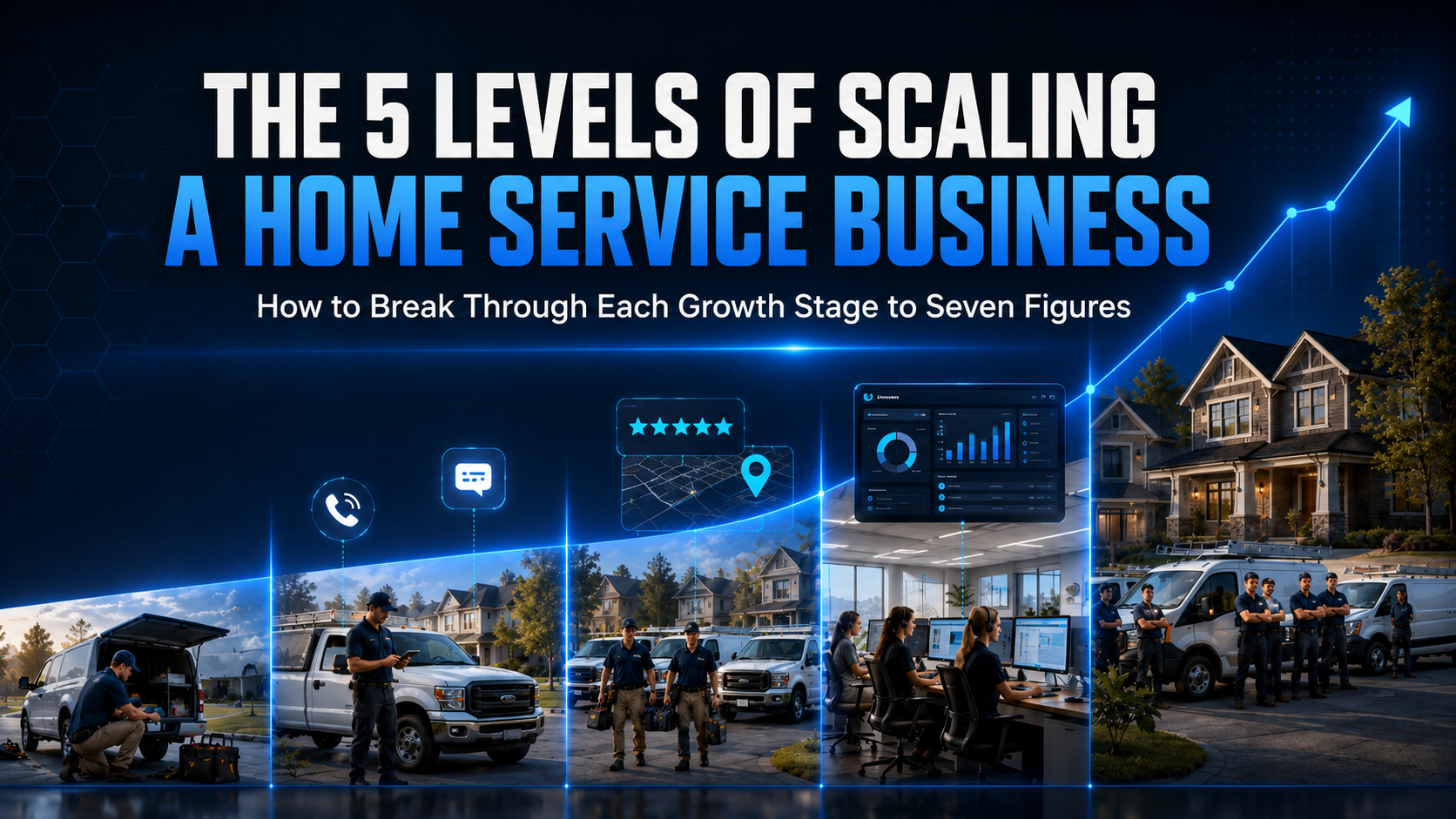
Here's a Quick Overview of the Five Growth Levels
- There are five unique revenue stages that every home service business goes through, and the bottleneck that's holding you back is different at each stage.
- One of the most expensive mistakes a contractor can make is buying more leads before fixing their follow-up, call handling, or website conversion.
- When you reach seven figures and beyond, your role changes from doing the work to managing strategy, systems, accountability, and quality control.
- A free gap analysis and 12-month growth plan can help identify if your current problem is visibility, lead conversion, pricing, staffing, or fulfillment capacity.
- The key to separating contractors who scale from those who stay stuck is sequencing your marketing investments correctly — putting the right systems in place at the right stage.
The problem for most home service businesses isn't a lack of leads. It's a sequencing problem.
No matter what kind of business you own, be it a roofing company, an HVAC business, a plumbing operation, an electrical contracting firm, a landscaping company, or any other trade, there is a predictable pattern that you can follow to scale your business from a startup to seven figures. Unfortunately, many business owners try to solve problems that they might face in the future before they have even fixed the problems they are facing today. They spend money on paid advertising when they don’t even have the capacity to answer their phones. They hire staff before they have the necessary systems in place. They are constantly chasing new leads, while completely ignoring the estimates that they have already sent and have not followed up on. 365 Lead Strategy works specifically with home service businesses to diagnose exactly where that misalignment is happening and build a plan that matches the right solution to the right stage.
It's essential to know the current state of your business and the obstacles preventing its growth in order to progress without squandering resources, time, and energy.
Why Most Home Service Businesses Don't Succeed: The Missed Steps
Scaling is not about doing more of everything at once. It's about identifying the one constraint that is limiting your next level of growth and removing it. Skipping steps creates fragile businesses that generate impressive revenue but collapse under pressure because the foundation was never built correctly. The contractor doing $400,000 a year who never fixed his follow-up process is leaving $150,000 on the table in unsold estimates alone. The owner doing $750,000 a year who is still running every sales call personally has already become the ceiling on her own company's growth.
Each level has its own set of challenges. Identifying yours is the first move.
What Does "Scaling" Really Mean for a Home Service Business?
The term is frequently used, but not many owners can accurately define it. Scaling is the process of increasing your revenue without a proportional increase in your costs. It's about your systems, your team, and your infrastructure handling more volume without requiring a corresponding increase in your personal time or overhead. If a business doubles its revenue by doubling everything — including the owner's hours — it's not scaling. It's just growing, and that's not sustainable.
Increasing Revenue Without Increasing Costs
Real scaling occurs when it costs you less to acquire and serve a new customer than it did the last one. It occurs when your dispatcher can handle twelve jobs a day instead of six without needing to hire another dispatcher. It occurs when your CRM automatically follows up on unsold estimates while your team is out working. As you grow, the gap between your revenue and your costs should increase, not decrease. If your costs are rising at the same rate as your revenue, you're dealing with a growth problem masquerading as a scaling problem.
Profitability vs Revenue: Why the Former is More Important at Each Stage
Consider this: a roofing company that makes $600,000 a year and has a net margin of 35% is in a much better position than a company that makes $900,000 a year but only has a net margin of 12%. Revenue is easy to see. Profit, on the other hand, is what actually funds your next hire, your next truck, your next ad campaign, and eventually your retirement. The ability to maintain a healthy margin at each level described below determines whether or not you can afford to make the necessary investments to advance to the next level. If the money isn't there, you won't be able to make the moves you need to make.
1. From Nothing to $100,000 a Year: The Part-Time Job Stage
Almost all home service businesses start off here, and it's perfectly okay to be at this stage. However, you need to be truthful about what this stage truly entails. For more insights, check out this gap analysis in marketing to uncover growth opportunities.
What Your Business Looks Like at This Stage
At the zero-to-$100,000 level, you are generating roughly $5,000 to $10,000 a month. You are likely doing most or all of the technical work yourself. Your customers are coming almost entirely from referrals, word of mouth, Facebook posts, and maybe a few neighbors who saw your truck. Your business exists, but it does not yet have the infrastructure of a business. It has the infrastructure of a very busy self-employed person.
What You Need to Focus on at This Stage
Your main task at this point, even if it doesn't seem that way, is simple. You need to bring in enough regular business to establish a cash flow, and you need to do the work well enough that people will recommend you to others. Everything else is secondary. This isn't to say you should neglect marketing, but you should realize that your immediate limitation is almost always exposure and generating opportunities, not your advertising strategy or automation.
- Answer every call personally and follow up on every inquiry the same day
- Ask every satisfied customer for a Google review immediately after the job
- Keep your Google Business Profile completely filled out with photos, services, and accurate hours
- Price your work correctly from the start — underpricing at this stage creates habits that are very difficult to break later
- Track where every job is coming from so you know what is already working
Most level-one owners undercharge because they are afraid of losing the job. This is one of the most damaging patterns in the trades. If your net margin is less than 30% to 40% at this stage, you are working very hard to stay poor. Fix the pricing now, before you have employees whose paychecks depend on a broken pricing model. For more insights, consider exploring gap analysis in marketing to uncover growth opportunities.
The Usual Obstacles for Level One Businesses
When a business is at this stage, the main issue is usually one of two things: either not enough people know about the business, or the people who do find it are not convinced to choose it. This is a problem of visibility and trust, not advertising. You can't fix a trust problem by buying more leads. You fix it by creating a credible presence that makes your business seem legitimate and worth hiring.
Marketing Basics Every Level One Business Must Have
Before you start investing in advertising, there are three things you need to make sure are working: a fully optimized Google Business Profile that is actively collecting reviews, a simple website that clearly explains your services, your location, and how to get in touch with you, and a habit of following up with every single person who contacts you. These three things cost next to nothing. They produce disproportionately high results at this stage because most of your local competitors haven't done them correctly either.
Google reviews play a significant role in this scenario. If a person is searching for a roofer or plumber in your area and they find a company with 47 reviews and an average rating of 4.8 stars, and your company only has 3 reviews with no responses, they're likely to choose the other company. The 365 Lead Strategy review management system assists businesses at this stage in building that trust signal systematically, instead of relying on customers to remember to leave a review.
Which Marketing Expenses Are Worth It (And Which Are Not)
When you're in the zero-to-$100,000 range, your marketing budget is tight and every dollar matters. The investments that will give you the most bang for your buck are the ones that make you look reputable and help people who are already searching for your service find you. Paid advertising isn't out of the question, but it should be minimal and targeted. Google Local Services Ads can be effective at this stage because you only pay when someone calls you directly. Traditional Google PPC campaigns require a larger budget and more management to be successful.
You shouldn't be wasting a lot of money on brand awareness campaigns, billboards, or social media management packages that promise engagement but don't bring in leads. When you're making $5,000 to $10,000 a month, you need customers, not followers. For more insights on effective marketing strategies, check out this article on gap analysis in marketing.
At this point, you don't need a fancy website. It should load quickly, clearly display your phone number, describe your services in a straightforward manner, and make it simple for someone to request a quote. If your website is getting traffic but isn't resulting in phone calls or form submissions, you have a conversion problem. A website that looks professional but doesn't convert is just a costly brochure.
Rewrite the following human content into AI content:
First Stage Priority Checklist
✓ Fully filled out Google Business Profile with images and categories
✓ Minimum of 10 Google reviews with responses
✓ Basic website with easily seen phone number and service area
✓ Regular follow-up on every inquiry within 60 minutes
✓ Pricing reviewed and adjusted to safeguard margins
✓ Every job source tracked, even if it's just in a notebook
Stop wasting time on activities that do not directly produce customers. Every hour you spend on something that does not generate revenue or build trust is an hour that pushes your breakthrough further away.
Breaking Through the First Level
Breaking through the first level requires generating consistent visibility in your local market, charging what your work is truly worth, and building a reputation that makes referrals and reviews work for you automatically. Once you are generating $8,000 to $10,000 a month reliably and your margins are healthy, you have the foundation and the cash flow to begin making the moves that the second level requires.
2. $100,000 to $300,000 a Year: The Critical Juncture
Once you hit $100,000 a year, you've confirmed your business model is viable. Customers are willing to pay for your services. This is the point where many home service businesses either make it or break it.
Characteristics of a Business at This Stage
When your business is generating $100,000 to $300,000 per year, you are bringing in $8,500 to $25,000 per month. You may have a small team of one or two employees, or you might still be working alone with subcontractors. Although you are getting more consistent work, it often feels like you are always chasing it. You are starting to accumulate a resource that is not your time, and that resource is money. The question is whether you invest it wisely or spend it reactively. To explore how strategic planning can help, consider learning about gap analysis in marketing.
Owners often make their costliest mistakes at this stage. They may hire too quickly, purchase equipment they don't need yet, or invest in marketing without a system in place to capture and convert the leads generated. Cash flow can seem deceptively stable until a slow month reveals the fragility of the foundation.
Why Home Service Owners Should Be Wary at This Stage
The $100,000-to-$300,000 range is a tricky one because it gives the illusion of stability. You're bringing in a substantial income. You feel like you've cracked the code. However, the methods that got you to this point — personally returning calls, keeping everything organized in your mind, manually writing estimates or using a basic spreadsheet — won't be sufficient to get you to the next stage. In fact, they'll actively hinder your progress. The moment you become so busy that you miss a call or take two days to send an estimate, you'll begin to lose jobs to competitors who have superior systems, not necessarily superior skills.
Mixed Marketing and Efficient Small Campaigns
When you're in the $100,000 to $300,000 range, you have enough of a cash flow to start investing in marketing beyond your Google Business Profile. However, you don't have enough to waste. The goal is to run small, targeted campaigns that produce measurable results. You can then reinvest what works. Google Local Services Ads are still a strong option at this stage. This is because the intent is high and the cost per lead is typically more predictable than broad PPC campaigns. If your website is converting visitors into calls at a reasonable rate, a small Google PPC campaign can start to fill gaps in your schedule during slower weeks.
This is the point where your follow-up system becomes as important as your lead generation. If you're sending out estimates and not following up within 24 to 48 hours, you're losing jobs that are already halfway sold. An automated CRM workflow that triggers a follow-up text or email after every unsent estimate can recover a significant percentage of those lost opportunities without any additional ad spend. The 365 Lead Strategy automated follow-up system does just that — it keeps your business in front of prospects who have shown interest but have not immediately booked, converting more of your existing leads into actual revenue.
At this point, you should also pay attention to your website. If you're running any paid traffic and your site isn't designed to convert visitors into calls or form submissions, you're essentially paying for people to leave. A clear headline, a visible phone number, strong reviews displayed prominently, and a fast-loading mobile experience are the non-negotiables. If visitors are landing on your site and leaving without taking action, that's a conversion problem, not a traffic problem, and buying more traffic won't fix it.
Why a Free Gap Analysis is Crucial at this Point
At the $100,000-to-$300,000 range, a free gap analysis and 12-month growth plan from 365 Lead Strategy can provide the most clarity. This is the phase where business owners are faced with the most decisions all at once — whether to hire, whether to advertise, which platforms to use, whether to invest in software — and making the wrong decisions in the wrong order can stall the business for years. A gap analysis cuts through the confusion by evaluating your current visibility, lead flow, website conversion, follow-up process, and review presence to identify what is actually holding you back rather than what just feels like the problem.
At this stage, a lot of business owners think that they need more leads. However, what they often find out through gap analysis is that they actually have enough leads. The problem is that they have poor follow-up, slow response times, unconverted estimates sitting in a spreadsheet, or a website that looks credible but does not compel action. Addressing these issues before spending more on advertising will yield a significantly better return on every marketing dollar spent afterwards.
How to Get Past the Second Level
There are three things that need to happen simultaneously in order to break through the $300,000 ceiling: you need to have strong enough pricing and margins to fund growth, your follow-up and conversion systems need to be capturing the leads you're already generating, and you need to start removing yourself from at least some of the direct labor so you can focus on the work that only the owner can do. If your net margin is only 15% to 20% at this stage, it will be extremely difficult to scale beyond it. You need margin to fund the employees, systems, and marketing that the next level requires.
Accumulate enough funds to hire reliable assistance and enhance your systems. The jump from earning $300,000 to $600,000 per year is not achieved by working more intensely. Rather, it's achieved by focusing on the business as a whole, not just the day-to-day operations. This change begins with the choices you're making at this second level.
3. $300,000 to $600,000 a Year: Building a Solid Foundation
At this point, things are starting to come together. Work is steady, you have a team in place, and your advertising efforts are paying off. However, there is a new and more serious issue: the owner is now the weakest link in the sales process, the fulfillment process, or both.
In this stage, you're not struggling to keep your head above water anymore. Instead, you're battling for systems. Every casual process that worked when you were a one-man show now causes problems, inconsistencies, and lost revenue at a larger scale. The contractor who handles every sales call personally can close deals all day, but the moment he's on a roof, those calls go to voicemail and the leads go to a competitor who picked up the phone.
The Appearance of Your Business at This Point
Your business is bringing in $300,000 to $600,000 annually, which is $25,000 to $50,000 monthly. You probably have a team of two to five employees or a dependable group of subcontractors. You're investing in advertising and it's paying off, but you might not have a clear picture of which channels are bringing in your best customers. You're starting to bump up against the limit of your own involvement in too many aspects of the business.
Before You Increase Your Ad Spend, Make Sure You’re Tracking and Attributing Your Leads Correctly
Many contractors at this level are running Google ads, maintaining a Google Business Profile, getting referrals, and occasionally running social media promotions. But they have no clear data on which source produces the most valuable customers. Before you increase your ad spend, you need to know which of your current marketing channels is actually producing paying customers — not just leads, but closed jobs with good margins. Otherwise, you’re just spending more money on the same uncertainty. The 365 Lead Strategy tracking and attribution system gives you a clear picture of where your best customers are coming from so you can double down on what works and stop funding what does not.
Level Three: Expanding Your Marketing Channels
When your business is generating between $300,000 and $600,000 per year, you have the budget to expand your marketing efforts. At this stage, Google PPC campaigns can be a valuable tool, as long as they are managed correctly with the right keywords and negative keyword lists. These campaigns can provide a steady stream of high-intent leads at a predictable cost. If your Local Services Ads are still producing results, you should continue to run them. It’s also a good idea to start investing in organic search and local near-me visibility. While these efforts may not produce immediate leads, they can help reduce your reliance on paid advertising in the long run.
When your website is getting a lot of traffic but no one is initiating a conversation, you can use an AI chatbot to capture those potential clients before they leave. A lot of people who need home services search for them at night or on the weekends when there's no one available to answer their inquiries. A chatbot can qualify the lead, get the person's contact information, and schedule a callback. This turns passive traffic into an active pipeline without needing anyone on your team to be up at 11pm.
Overcoming the Third Level
As you start to move from the third to the fourth level, you need to start removing yourself from the revenue-generating activities. This can mean training someone else to handle the sales calls or at least manage the initial inquiry and estimation process through a system instead of relying solely on your personal involvement. As you start to approach the $500,000 to $600,000 a year mark, it's time to start hiring more support in sales and other areas so that your ability to produce isn't limited by your personal availability.
Keep purchasing efficiency with money rather than attempting to do everything on your own. Every dollar you spend on a system or individual that saves your time from a task that someone else can do is a dollar invested in your ability to expand. Get the business ready to run without you always being there. That readiness is what makes the next level achievable.
4. $600,000 to $1 Million a Year: Systematizing for Scale
Reaching $600,000 a year is a huge achievement. Most home service businesses never get here. But this stage brings a specific and humbling challenge: the systems you thought were strong will start failing under the increased volume of a business approaching seven figures.
How the Business Appears at This Point
When you're making between $600,000 and $1 million per year, you're processing $50,000 to $83,000 per month through your business. You have actual employees, several teams or technicians, a substantial advertising budget, and an increasing reputation in your market. You're also dealing with more complexity than at any previous level — more jobs, more customer interactions, more scheduling difficulties, more estimation demands, more follow-up needs, and more chances for things to slip through the cracks.
The informal systems that got you from $100,000 to $600,000 — the mental reminders, the text threads with team members, the spreadsheet of open estimates, the post-its on the dashboard — are now actively causing you to lose money. At this volume, a missed call is not just an inconvenience. It is a $3,000 to $15,000 job walking out the door.
Why Unifying Your Systems is Essential at This Level
When your customer information is scattered across personal cell phones, email inboxes, paper estimate pads, and three different apps that don't communicate with each other, you are losing revenue every day without knowing exactly where it's going. A lead comes in through the website contact form. Someone calls back from a personal cell. The estimate gets texted to the customer. No one follows up when the customer goes quiet. Six weeks later, that customer has already hired your competitor. A unified CRM like 365 Lead Strategy's CRM HubOne brings together every lead, every conversation, every estimate, and every follow-up into one visible system so nothing gets lost in the noise of a busy operation.
The Automated Systems That Can Handle Several Teams
When you're dealing with this much revenue, you can't rely on manual processes. The automated systems you set up now will decide whether your business can deal with twice as much work without needing twice as many administrators. The main parts aren't difficult, but they all need to be working together at the same time. For more insights, you can explore gap analysis in marketing to uncover growth opportunities.
- Instantaneous lead response: Each new lead receives an immediate text or email response, ensuring that no lead feels neglected while your team is busy on the job.
- Automated text-back for missed calls: If a call goes unanswered, an automated text is sent out within seconds to keep the lead engaged and prevent them from reaching out to your competitors.
- Automated follow-up sequences for estimates: After each estimate is sent, a sequence of follow-up messages is automatically sent until the lead either books, declines, or requests more time.
- AI voice agent for after-hours calls: An AI voice agent manages incoming calls after business hours, qualifies the caller, collects their information, and schedules a callback, thereby capturing revenue that would otherwise be lost.
- Automated review requests: After each job is completed, a review request is automatically sent out, allowing your Google rating to continuously grow without anyone having to remember to ask.
These automations do not replace your team. Rather, they enhance your team's effectiveness by managing the repetitive, time-sensitive tasks that often fall by the wayside during a busy day. The aim is to create a business where leads are captured, followed up on, and converted without requiring the owner to personally oversee every interaction.
How to Advance Past Level Four
The transition from $600,000 to $1 million requires the owner to undergo a fundamental change in identity. You are no longer the top technician, the top salesperson, or the most responsive person in the company. You are the person who assembles the team, upkeeps the systems, and makes the strategic decisions that keep everything progressing in the right direction. Every task you are still personally executing that someone else could be trained to do is a task that is capping your company’s potential.
At this point, it's a good idea to review your gap analysis and 12-month growth plan. The company you're running at $700,000 per year isn't the same as the one you had at $250,000 per year. Your marketing, staffing, and systems needs have changed, as have your bottlenecks. Reevaluating now will keep you from using level-two fixes for level-four issues.
5. Over $1 Million per Year: Market Domination
When you cross the seven-figure threshold in a home service business, you join an exclusive club. However, you also reach a point where the very instincts that propelled you to this level can become your undoing if you don't tread carefully. Understanding gap analysis in marketing can help you identify growth opportunities and avoid potential pitfalls.
What the Business Looks Like at This Stage
Once you are generating over $1 million a year, you are making over $83,000 a month. You have a team with defined roles, a recognizable brand in your market, consistent advertising that produces results, and enough operational complexity that your personal involvement in daily operations is either already reduced or urgently needs to be. The primary needs of the business now fall into four categories: sales systems, fulfillment capacity, operational infrastructure, and marketing that compounds over time rather than just producing leads today.
Why Marketing Isn't Your Main Concern at This Level
When you hit seven figures, visibility is no longer an issue. You've established a name for yourself. Your Google Business Profile is brimming with reviews. Your trucks are a common sight throughout your service area. Your marketing strategy is in full swing. The question is whether your business can keep up with the demand generated by your marketing efforts without sacrificing quality, speed, or consistency. A single negative review at this stage, or a week of delayed responses due to the departure of a key employee, could result in greater revenue loss than a month's worth of advertising expenses.
Capitalizing on Existing Success
At this point in the game, the best marketing strategy isn’t typically to discover a new channel. Rather, it’s to get more out of the channels that are already working. If Google PPC is bringing in your best customers, you need to ask yourself if your budget is in line with the available opportunities in your market, and if your landing pages and follow-up process are converting at the highest possible rate. If your Google Business Profile is generating a significant number of calls, you need to make sure that every call is being answered, logged, and followed up on without fail.
Here, it is logical to make broad, long-term visibility investments. Strategies such as organic search, GEO targeting, and sustained local near-me visibility campaigns create compounding assets that decrease your cost per lead over time. A business that generates $1 million to $2 million a year can handle the three-to-six-month ramp-up period that organic strategies necessitate, and the long-term benefit in reduced ad dependency is considerable. The businesses that rule their local markets at this level are nearly always doing both — using paid advertising for immediate lead volume while also building organic visibility that operates for free in the background.
How to Break Through Level Five
Breaking through seven figures and continuing to scale requires the owner to function as a CEO, not as the best technician or salesperson in the company. Your job at this level is strategy, systems, accountability, resource allocation, and quality control. You are deciding which markets to enter, which services to add or cut, which managers to promote, and which marketing investments to scale. If you are still personally closing sales, running jobs, or managing day-to-day scheduling at $1 million a year, you have built a very expensive job rather than a scalable business. The transition from operator to owner is the real breakthrough at level five, and it does not happen by accident. It happens by deliberately building the leadership team, the systems, and the accountability structures that allow the business to perform at a high level without requiring your daily involvement in operations.
Identifying the Right Next Step with a Free Gap Analysis
Each section of this article has discussed a different bottleneck, because the bottleneck truly changes at every stage. The obstacle for a $75,000-a-year business is entirely different from the obstacle for a $750,000-a-year business. This is exactly why buying marketing services, software, or advertising without first understanding where the actual constraint is, is one of the most common and costly mistakes home service owners make. A free gap analysis and 12-month growth plan from 365 Lead Strategy is specifically designed to solve this problem — to assess your business at its current stage and identify the specific lever that will create the most significant growth when pulled.
What Does a Gap Analysis Really Look At?
A thorough gap analysis looks at every aspect of your business that could be affecting its growth, not just the marketing side of things. It looks at how visible you are in local searches, how strong your Google Business Profile is and how many reviews you have, how well your website is doing at converting traffic into calls and form submissions, how quickly and consistently you’re following up with leads, how well your calls are being handled during and after business hours, whether or not your CRM is capturing and tracking every lead, which marketing channels are actually bringing in paying customers versus just generating impressions, and whether or not your current sales process is converting estimates at a healthy rate. The result is not a one-size-fits-all marketing proposal. It’s a prioritized diagnosis of where your business is losing money and a sequenced plan for addressing each gap in the right order.
How to Avoid Wasting Money at Every Stage
In the home service industry, the most common way to waste marketing money isn't a bad ad campaign. It's when a business buys leads it can't handle, traffic it can't convert, or advertising that targets customers it can't serve profitably. A contractor who can't consistently answer calls shouldn't be running aggressive Google PPC campaigns. The calls will come in, go to voicemail, and the prospect will call the next result on the page. The ad budget is spent, the lead is lost, and the owner concludes that Google ads don't work — when the actual problem was the lack of a call-handling system.
Order is important. Before you buy more traffic, fix the conversion problems. Before you generate more leads, fix the follow-up problems. Before you expand your service area, fix the fulfillment problems. A gap analysis forces this order to be explicitly discussed rather than allowing a business owner to jump right into the exciting parts of marketing while leaving critical gaps in the foundation underneath.
Automation and software are no different. A business making $80,000 a year doesn't need a CRM system with thirty integrations. On the other hand, a business making $900,000 a year can't afford to be running customer information out of a spreadsheet and a group text thread. Having the right tools at the right stage prevents both under-investment and over-investment, both of which can stall your growth.
What a 365 Lead Strategy Gap Analysis Evaluates
Visibility: Google Business Profile completeness, review volume and recency, local search rankings, near-me presence
Traffic: Website visitor volume, traffic sources, paid vs. organic breakdown, keyword positioning
Conversion: Website call-to-action effectiveness, form submission rate, mobile experience, page load speed
Call Handling: Answer rate, after-hours coverage, missed call follow-up speed, AI voice agent opportunity
Follow-Up: Estimate follow-up timing, automated sequences, unsold estimate recovery rate
CRM & Tracking: Lead source attribution, pipeline visibility, data centralization, reporting accuracy
Reviews: Review velocity, response consistency, platform coverage, reputation management
Sales Process: Estimate-to-close rate, average job value, upsell consistency, pricing structure
Scaling Is About the Right System at the Right Time
There is no universal playbook for scaling a home service business, because the right move depends entirely on where you are right now. A tactic that produces breakthrough results at $200,000 a year can be irrelevant or even counterproductive at $800,000 a year. The businesses that scale successfully are not necessarily the ones with the biggest advertising budgets or the most sophisticated technology. They are the ones that clearly understand their current bottleneck, address it with the appropriate solution, and then move to the next constraint in the right order.
This means you need to fight the temptation to do everything at once. You need to honestly assess which issues are truly hindering your growth and which issues just seem urgent when you're having a rough day. You need to keep track of the important things, like response times, close rates, where your leads are coming from, and net margin by service type, and make decisions based on data rather than on your gut or what it looks like your competitors are doing. Most owners don't lack the drive to succeed. What they lack is a clear, step-by-step plan that matches the right actions to their current stage of growth.
It's possible to increase your annual income from $75,000 to $750,000 and even $7 million. Contractors in various home service industries, such as roofing, HVAC, plumbing, electrical, landscaping, and remodeling, have achieved this. The ones who were successful didn't do so by working harder than everyone else. Instead, they did it by addressing the appropriate issue at the right time, creating systems that could handle increased volume, and eventually building teams and infrastructure that enabled the business to expand without proportionately increasing the owner's workload.
Commonly Asked Questions
The questions below are the ones most frequently asked by home service business owners who are trying to determine their next steps. Knowing where your business stands in relation to these answers is the first step towards making more informed decisions about marketing, systems, and growth.
Here are some common questions I get:
- What are the five levels of scaling a home service business?
- When should a contractor start paying for professional marketing?
- What does a marketing gap analysis reveal?
- Which marketing systems should be implemented first?
- How can a contractor tell whether the problem is lead generation or lead conversion?
- What changes in the owner’s role after the company reaches seven figures?
I get these questions all the time. The truth is, most of these questions are best answered with: it depends on where you are in your business. The following answers are designed to give you a framework for thinking through your specific situation rather than a one-size-fits-all prescription.
How Can I Determine My Home Service Business's Current Growth Level?
Although your revenue level is the starting point, it is not the only indicator. A business making $280,000 a year with a 35% net margin and an effective follow-up system is in a significantly different position than a business making $280,000 a year with a 14% margin and no CRM. Use the revenue ranges as a rough guide, then honestly evaluate your margins, your systems, your team, and how dependent the business is on your personal daily involvement. These four factors combined will give you a better understanding of your actual stage than revenue alone. For more insights, you can explore gap analysis in marketing to uncover growth opportunities.
Unsure of where you're at? The quickest way to gain clarity is by conducting a gap analysis. This evaluates your business across all dimensions that impact growth, not just your marketing budget. Many owners discover through this process that their systems are only at level two, even though their revenue is at level four. This is why growth has stalled, even though they're spending more on ads.
Why Should Contractors Care About Marketing Gap Analysis?
Marketing gap analysis is a methodical review of your company that pinpoints the exact differences between your current state and the state you need to be in to advance to your next income level. As a contractor, this means looking at visibility, website conversion, lead response times, follow-up systems, call handling, CRM usage, review volume, and marketing attribution — not just whether you are running ads. The gap analysis creates a ranked list of what needs to be repaired first, second, and third, so your investment goes into the constraint that is actually limiting your growth rather than the area that feels most urgent or most exciting.
When is a Home Service Business Ready to Start Investing in Professional Marketing?
- Your Google Business Profile is fully optimized and actively gathering reviews
- Your website is mobile-friendly and effectively converts visitors into calls or form submissions
- You or a member of your team consistently answers calls during working hours
- You have a follow-up process in place for every quote you provide
- Your pricing strategy ensures a net margin of at least 30% to 40% in the early stages
- You can track the source of your current customers
If these foundations are not in place, professional marketing will generate leads that slip through the cracks of a flawed system. You will waste money on traffic that does not convert, calls that go unanswered, and quotes that are not followed up on. The marketing budget is not wasted because the marketing was unsuccessful — it's wasted because the infrastructure required to capture and convert the leads it generated was lacking.
After the foundation is strong, you should invest in professional marketing when you have steady income, good profit margins, and the ability to take on more work than you currently have. At that point, spending money on marketing is like pouring gasoline on a fire that's already burning. This is much more effective than trying to use advertising to start a fire from nothing.
Typically, home service businesses reach a point where they need to invest between $100,000 and $300,000 in foundational marketing. This is followed by an investment of $300,000 to $600,000 to expand into broader channels such as Google PPC, Local Services Ads, and organic search development. The exact point at which these investments need to be made depends on factors such as your market, your profit margins, and your current conversion rate. A gap analysis can help you determine the right time to make these investments for your specific business.
When Should I Implement CRM Automation and What Kind Do I Really Need?
The truth is that you need CRM automation sooner than most contractors realize, and it's simpler than most software vendors would have you think. When you're at the $100,000-to-$300,000 stage, the most beneficial automations are missed call text-back, estimate follow-up sequences, and review request triggers after jobs are finished. These three automations alone can recapture a large percentage of leads that would otherwise go stale, without the need for complex setup or a big software budget.
When your business is bringing in between $300,000 and $600,000, or even more, it's crucial to have a centralized CRM that brings together every lead, conversation, and estimate into a single, visible pipeline. When information is spread across personal phones, email inboxes, paper pads, and disconnected apps, it creates blind spots that can cost a significant amount of money when you're dealing with larger volumes. CRM HubOne from 365 Lead Strategy is designed specifically for home service businesses at this stage, centralizing customer information, automating follow-up, and providing the owner and team with a single source of truth for every active opportunity.
CRM Automation by Revenue Stage
$0 – $100K: Manual follow-up with a simple contact log; focus on responding to every inquiry the same day
$100K – $300K: Missed call text-back, estimate follow-up automation, post-job review request trigger
$300K – $600K: Centralized CRM pipeline, lead source tracking, automated nurture sequences, job status notifications
$600K – $1M: Full CRM integration with scheduling, AI voice agent for after-hours, AI chatbot on website, detailed attribution reporting
$1M+: Enterprise CRM with team accountability dashboards, automated reporting by revenue source, multi-location pipeline visibility
Add automation in layers as your volume justifies it. The goal is never automation for its own sake — it is automation that captures revenue you are currently losing to slow response times, missed follow-ups, and unanswered calls.
Why Aren’t My Leads Converting Even Though I Have a Lot of Them?
When you have a high volume of leads but a low conversion rate, it usually means one of four things is happening: your response time is too slow and prospects have already moved on by the time you get to them, your follow-up process stops after one try instead of the multiple tries most prospects need before booking, your pricing is positioned incorrectly compared to how you are presenting value on your website and in your estimates, or your sales process has gaps that cause friction between the initial inquiry and the signed contract. Before you buy more leads, audit your existing pipeline for the past 90 days. Count how many estimates you sent, how many you followed up on more than once, and how many resulted in a booked job. The gap between those numbers is your real conversion problem, and it will not be fixed by generating more leads into the same broken process.
Is it possible to grow a home service business beyond seven figures without paid advertising?
It is possible — although the growth will be slower and in most competitive markets, there are practical limits on how fast a business can scale using only organic growth. The businesses that most consistently reach and exceed seven figures are those that use paid advertising to generate volume in the short term while also building organic visibility, review volume, and referral systems to reduce their cost per lead over time.
The Difference Between Paid and Organic Marketing at Scale
Google PPC / Local Services Ads: Instant high-intent leads, predictable cost per lead, ceases to function the moment you stop paying
Google Business Profile + Reviews: Increasing visibility, trust signal for all traffic sources, operates continuously without direct ongoing cost
Organic Search / Near-Me Visibility: Long-term lead generation asset, lower cost per lead at maturity, three-to-six-month ramp time before meaningful results
Referral Systems: Highest close rate and lowest cost per acquisition, requires consistent customer experience and deliberate referral prompting
GEO Targeting / Local Content: Gradually builds broad market presence, supports all other channels by reinforcing name recognition
Contractors who rely solely on referrals and organic search often reach a comfortable plateau and then stop growing because there is a limit to organic reach in competitive markets, and referral volume is linked to current job volume rather than desired job volume. Breaking through this plateau almost always necessitates the introduction of paid advertising at the appropriate stage — typically when the foundation is strong enough to convert the traffic it generates.
The top performing seven-figure home service businesses do not rely on a single dominant marketing channel. Instead, they have a presence on multiple channels, with clear attribution data showing which ones produce the most valuable customers. They also have a systematic process for following up on every lead those channels generate. This combination of broad visibility, strong conversion, and disciplined follow-up is what sustains growth past seven figures, rather than just producing a spike in revenue followed by a plateau.
Are you committed to pinpointing your present bottleneck and crafting a growth strategy that suits your particular stage? Then, take the free 365 Lead Strategy gap analysis. You will receive a tailored 12-month growth plan that will guide you on what to rectify first, what to develop next, and when to implement each marketing investment to ensure that your expenditure generates results rather than mere activity.
365 Lead Strategy assists businesses in the roofing, HVAC, plumbing, electrical, landscaping, remodeling, and other home service sectors in pinpointing their precise growth bottleneck. They also create marketing systems, automation, and visibility that are appropriate for their current phase. This ensures that every dollar invested propels the business forward rather than plugging holes in a leaking foundation.


Share this article